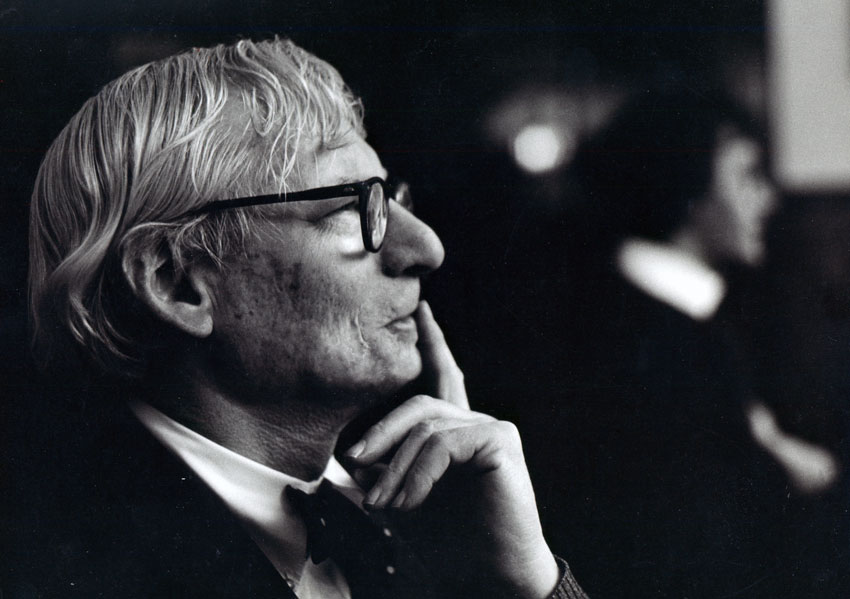
Louis Isadore Kahn (born Itze-Leib Schmuilowsky; March 5 [O.S. February 20] 1901 – March 17, 1974) was an Estonian-born American architect based in Philadelphia. After working in various capacities for several firms in Philadelphia, he founded his own atelier in 1935. While continuing his private practice, he served as a design critic and professor of architecture at Yale School of Architecture from 1947 to 1957. From 1957 until his death, he was a professor of architecture at the School of Design at the University of Pennsylvania.
Kahn created a style that was monumental and monolithic; his heavy buildings for the most part do not hide their weight, their materials, or the way they are assembled. Famous for his meticulously built works, his provocative proposals that remained unbuilt, and his teaching, Kahn was one of the most influential architects of the twentieth century. He was awarded the AIA Gold Medal and the RIBA Gold Medal. At the time of his death he was considered by some as “America’s foremost living architect.”
IIM Ahemdabad
While Louis Kahn was designing the National Assembly Building in Bangladesh in 1962, he was approached by an admiring Indian architect, Balkrishna Doshi, to design the 60 acre campus for the Indian Institute of Management in Ahmedabad, India. Much like his project in Bangladesh, he was faced with a culture enamored in tradition, as well as an arid desert climate.
For Kahn, the design of the institute was more than just efficient spatial planning of the classrooms; he began to question the design of the educational infrastructure where the classroom was just the first phase of learning for the students.
The large facade omissions are abstracted patterns found within the Indian culture that were positioned to act as light wells and a natural cooling system protecting the interior from India’s harsh desert climate. Even though the porous, geometric façade acts as filters for sunlight and ventilation, the porosity allowed for the creation of new spaces of gathering for the students and faculty to come together.


 Bhargavi N